



CausalX.ai on Databricks
Own the Context Behind Every
Enterprise Decision

How Celebal Tech combines industry ontology, causal reasoning and an open lakehouse foundation to reduce black-box dependency, lower cost and move from descriptive analytics to explanation and governed action.
Most enterprises now recognize that owning data is not enough. The durable advantage lies in owning the context that turns data into a decision: the definitions, relationships, causal assumptions, policies, constraints and intervention logic used to interpret an event and choose a response. When that context is encoded inside a closed, services-heavy decision platform, the enterprise may gain early speed but can also inherit high customization costs, limited explainability and long-term dependency on specialist teams.
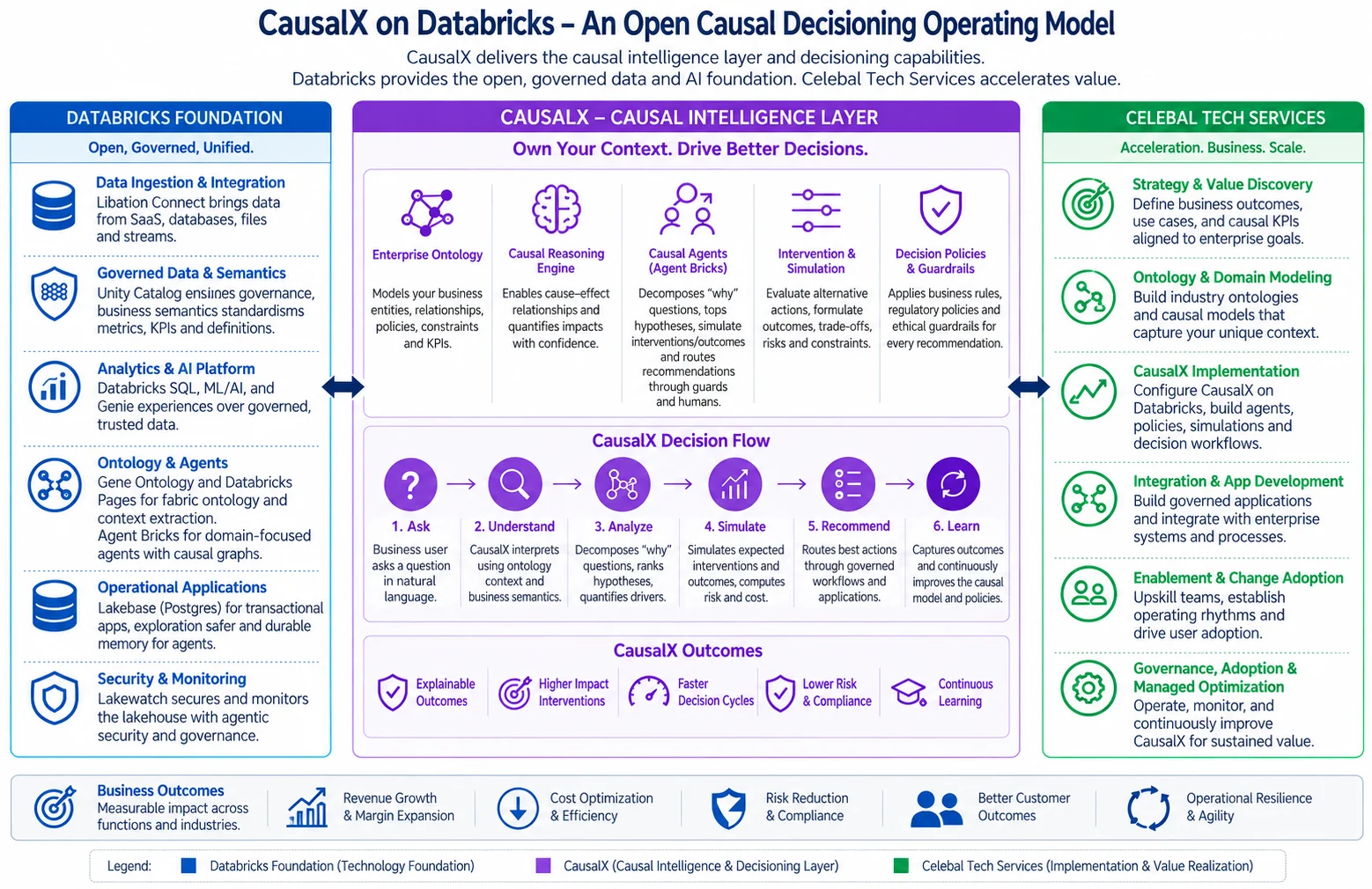
Celebal Tech’s CausalX, built on Databricks, is designed to change that equation. CausalX creates a governed causal decision layer on top of the customer’s data estate. It combines industry ontology, business semantics, causal reasoning, agents and decision orchestration, so leaders can move from “what happened?” to “why did it happen, what can we change and what action should we take?” Databricks supplies the open data and AI foundation; CausalX supplies the business context and causal decision logic; Celebal Tech Services delivers that model specific to the enterprise and operational at scale.
By keeping data, context and decision history in the customer’s governed environment, CausalX is designed to reduce the cost and dependency associated with black-box solutions. The same ontology, causal structures and agent patterns can be reused across functions and use cases, lowering the marginal cost of each new decision workflow.
Proprietary Forward-deployed-engineering-style programs solve difficult operational problems by embedding specialists into the business and encoding data relationships, rules and workflows in a proprietary operating layer. That model can produce visible results quickly. The structural risk appears later: business logic is difficult to inspect, reuse or transfer; each extension requires scarce expertise; data and semantic models may be recreated outside the enterprise’s primary platform; and leaders cannot easily determine which assumptions shaped a recommendation.
Context is the hidden cost center. A metric such as margin, churn, service level, risk or asset availability has meaning only when it is connected to a specific business definition, time horizon, operating condition, policy and set of available interventions. When those definitions are embedded in a closed implementation, the enterprise is effectively renting its own understanding of the business. CausalX treats that context as a governed enterprise asset rather than a vendor-controlled artifact.
Owning context turns business semantics into a reusable decision asset
CausalX creates an executable representation of how the enterprise operates. Customers, products, assets, suppliers, contracts, transactions, events, KPIs, policies, constraints and possible actions are connected in a shared ontology. The ontology is not limited to describing relationships; it also captures causal direction, operating conditions, intervention points and decision rights. This makes the business model useful for analysis, agent reasoning, simulation and operational action.
A conventional graph may show that a supplier, material lot, production line and defect are related. CausalX addresses the higher-value question: which pathway plausibly explains the defect, what evidence supports that conclusion, what alternative explanations remain, and which intervention is both feasible and permitted? It combines deterministic business rules and policies with causal structures and evidence; it does not ask leaders to accept a model narrative simply because it sounds plausible.
Databricks provides the open foundation; CausalX provides the causal decision system
Databricks provides the governed data, AI, semantic, application and operational services on which the solution runs. CausalX combines those capabilities into an industry-specific decision system that answers “why,” evaluates interventions and governs action. Celebal Tech Services connects the product and platform to the customer’s operating model.
At the data layer, Lakeflow Connect can bring operational sources into governed pipelines, while Unity Catalog provides the security, lineage and access model. Unity Catalog Semantics and metric views establish consistent KPI definitions. Genie Ontology can help discover and maintain a map of enterprise knowledge; CausalX extends that context through domain curation, causal direction, intervention levers, policies and cross-functional operating logic. The distinction is important: discovering relationships is valuable, but it is not the same as creating an enterprise causal model.
At the reasoning and experience layers, Agent Bricks can support agent development, evaluation and tracing; Genie One can provide a business-user entry point with Genie offering NLP based data extraction and Genie Ontology provides the latent ontology, and Databricks Apps can deliver decision workflows. Lakebase can persist application state, approvals, agent memory and decision history. Where low-latency operational serving is required and available, Lakehouse//RT can support application and operational analytics queries. Lakewatch can extend the same governed decision pattern to security-specific telemetry, investigation and triage when security operations are in scope.
Consider a multi-plant manufacturer experiencing a sustained decline in product margin. Traditional reporting may show that material cost, energy consumption, production variance and expedited freight have all increased. It may even identify the plants, products and periods with the largest variance. However, it does not necessarily establish which factors caused the deterioration, how those factors interacted, or which corrective intervention is most likely to recover margin without creating new operational risks.
CausalX begins by interpreting the executive question: "Why has margin declined for this product family, and what actions can recover it?" It traverses the manufacturing ontology to connect customer orders, product specifications, bills of material, suppliers, production lines, work orders, process conditions, quality events, maintenance history, inventory positions, freight movements and financial outcomes. The ontology ensures that the analysis is grounded in the company's own operating definitions rather than generic model assumptions.
Causal agents then decompose the question into competing hypotheses. These may include an adverse product mix, raw-material substitution, declining first-pass yield, excessive equipment changeovers, unplanned downtime, production-plan instability, energy inefficiency, supplier variability, overtime or premium logistics. Each hypothesis is tested against governed evidence, temporal relationships, process dependencies and known operating constraints.
The analysis may determine, for example, that the apparent increase in material cost is not the primary cause of margin loss. The causal pathway may instead show that supplier-quality variability increased process instability, which reduced first-pass yield, generated additional rework, delayed production completion and ultimately increased expedited freight. CausalX makes this pathway visible and quantifies the contribution of each driver to the financial outcome.
CausalX can then simulate approved interventions, such as changing the supplier allocation, adjusting process-control limits, modifying campaign sequencing, advancing preventive maintenance or temporarily reallocating production to another line. Each intervention is assessed for its expected margin impact, service-level implications, quality risk, capacity constraints and implementation cost. The recommended action is routed through a governed workflow for review by plant operations, supply chain, quality and finance before execution.
The required data remains on the Databricks foundation, while CausalX provides the ontology, causal reasoning, intervention logic, decision policies and audit trail. Lakebase can retain scenario state, approvals and decision history; Databricks Apps can present the recommendation and approval workflow; and real-time operational signals can be used to monitor whether the intervention produces the expected result. Celebal Tech Services supports the design of the manufacturing ontology, validation of causal pathways, integration with operational systems and adoption of the new decision process.
Strategic conclusion
CausalX.ai powered by Databricks is an open causal decision platform powered by Industry Ontology. It helps enterprises move from dashboards to explanations, from explanations to interventions, and from interventions to governed action. Most importantly, it allows leaders to own the logic behind their decisions. In an era where AI will increasingly influence operational, financial, and strategic choices, that ownership matters.
The winning enterprise architecture will not be the one that hides intelligence inside a proprietary black box. It will be the one that makes intelligence explainable, causal, governed, reusable, and actionable. That is the role of Celebal Tech's CausalX.ai on Databricks: to help organizations ask better why questions, understand causal drivers, and act with confidence on an open, governed, cost-efficient platform.