


From "What Happened" to "Why":
How CausalX and Databricks
Genie Are Making Data
Conversational

Every enterprise dashboard answers the same question: what happened? Revenue dipped. Asset downtime. Costs spiked. SLA missed. The number is on the screen, the color is red, and the leader staring at it has only one question that actually matters: why?
CausalX was built to answer that question deterministically. A causal engine, an enterprise ontology, and a library of pre-built agents traverse business data to isolate the real drivers of KPI change, not statistical correlations, not LLM-imagined narratives, but auditable causal paths with quantified financial impact attached. That has been our core promise from day one.
But there is always a second question that follows the first: “Show me the breakdown.” “Which segments are affected?” “How does this compare to last quarter?” These are not root-cause questions: they are exploration questions, the natural follow-ups any analyst, executive, or operator asks once a finding lands. And until recently, answering them meant either hand-coding a SQL query or filing a request with the data team.
That is what changed when we wired Databricks Genie into CausalX.
The Anatomy of a Causal Engine
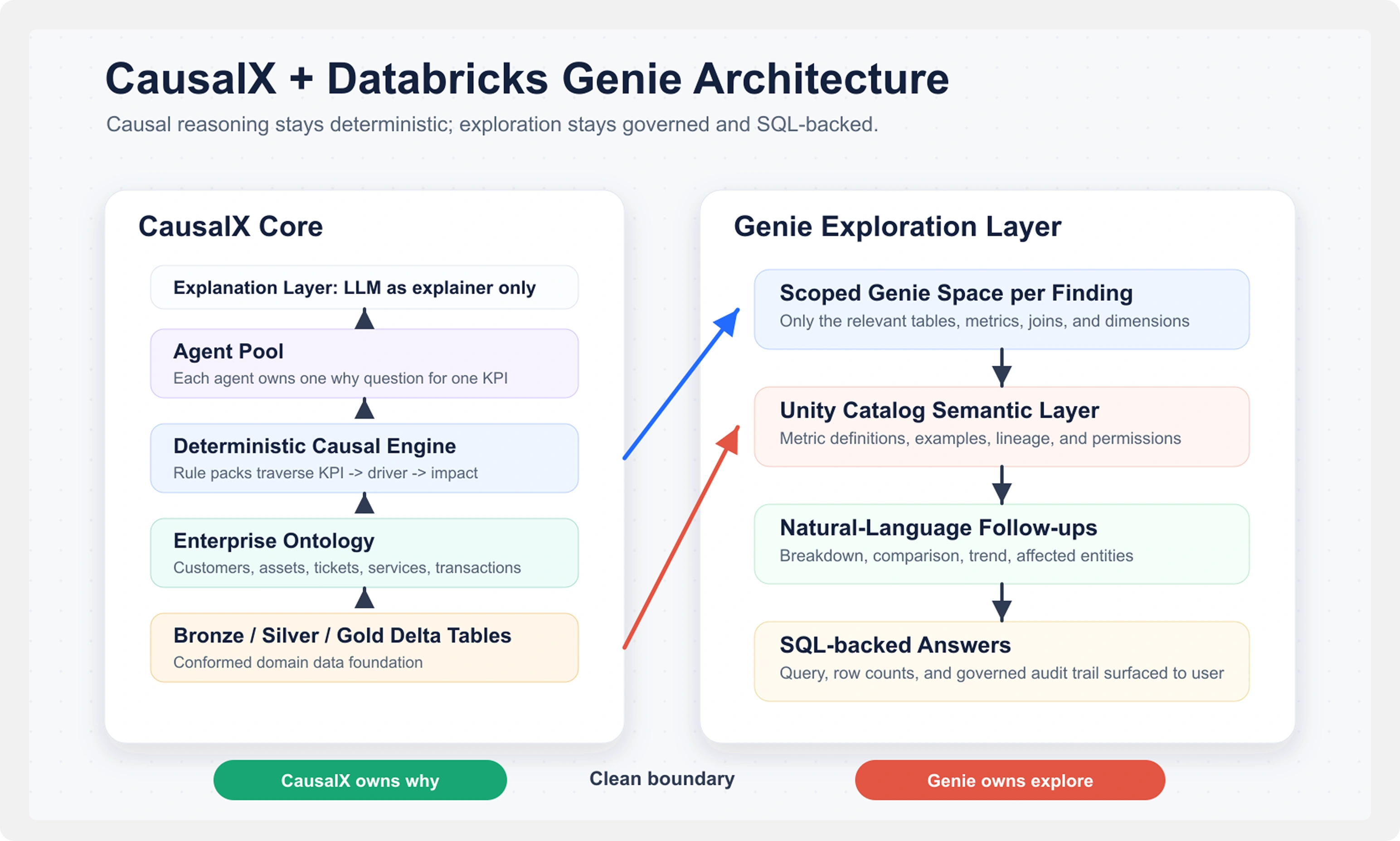
CausalX is a domain-agnostic causal intelligence product built natively on Databricks. It has been deployed across supply chain, financial services, energy, IT operations, and customer experience use cases. The architecture is layered and deliberate, and the same pattern holds regardless of the industry:
Data Foundation
Bronze, Silver, and Gold delta tables conform to a domain ontology. The ontology objects change with the use case (Customers, Accounts, Transactions for FS; Assets, Work Orders, Crew for asset-heavy; Tickets, Services, Incidents for IT ops) but the layered shape does not.
Causal Engine
A deterministic, rule-pack driven engine that traverses ontology links from a KPI deviation back to its root cause, with a financial impact figure attached to every finding. The rules are configurable per domain; the engine is not.
Agent Pool
Pre-built agents grouped into families per use case. Each agent owns one “why” question for one KPI and is wired to the ontology slice it needs.
Explanation Layer
A large language model wired in strictly as an explainer. It receives the structured causal findings and translates them into business prose. It is forbidden, by prompt and by design, from inventing causes that are not in the input.
Causal first, AI second. The engine commits to a finding before any LLM is invited to speak about it. That is what makes CausalX outputs auditable in any regulated or high-stakes environment.
The "Explore" Gap: Why Genie is the Missing Link
Databricks Genie is a natural-language data interface that sits on top of Unity Catalog. Given a curated set of tables, metrics, and example questions, Genie lets a business user ask data questions in plain English and get back governed, accurate, SQL-backed answers.
On its own, Genie is powerful but generic; it answers what a user asks. CausalX, on its own, is precise but bounded; it answers a fixed set of "why" questions for the KPIs each agent owns. Putting them together solves a real product problem: the moment after a causal finding lands.
The pattern is the same across every CausalX deployment:
A CausalX agent surfaces a finding (primary driver, sub-drivers, financial impact). The user reads it, then asks: "Show me the breakdown by segment." Pre-Genie, this meant a ticket and a long wait. Post-Genie, it’s an answer in seconds against governed data.
The causal agent owns the "why"; Genie owns everything that comes after.
Causal Intelligence in Action: Three Use Cases
1. Post-Analysis Exploration
Every CausalX agent output now ships with a Genie space attached. The Genie space is pre-scoped to the relevant ontology slice—only the tables, metrics, and dimensions related to the finding the agent has just delivered. This narrow scoping is deliberate: it means follow-up questions get answered against the right joins and the right metric definitions, not a global pile of Gold tables.
2. Self-Service Inquiry
CausalX Gold facts are exposed as a Genie space accessible from the CausalX home screen. Business users can ask straight KPI questions (“What was KPI for segment last week?”) without invoking an agent at all.
3. Querying the "History of Why"
The causal findings table is itself a Gold table. Once we exposed this to Genie, users started asking questions we hadn’t anticipated: “What were the top three root causes for this KPI across all business units in Q1?” or “Which root cause has cost us the most money YTD?” Genie turns structured findings into a queryable history of what went wrong.
Hard-Won Lessons from the Integration
A few honest observations from the build, useful regardless of the industry you are deploying into:
Curate the semantic layer first
Genie is only as good as the metric definitions and example questions you seed. Skip this, and Genie hallucinates joins.
Keep the boundary clean
Genie does not need to know about the causal engine. The agent owns causal reasoning; Genie owns data exploration.
Scope spaces narrowly
By scoping each Genie space to a finding’s ontology slice, accuracy spikes. A global Genie space is a recipe for ambiguity.
Audit trail matters
Every Genie answer surfaces the SQL it ran. In regulated environments like finance, healthcare, energy, the LLM said so is not an answer. The SQL is.
The Next Frontier: Closing the Loop
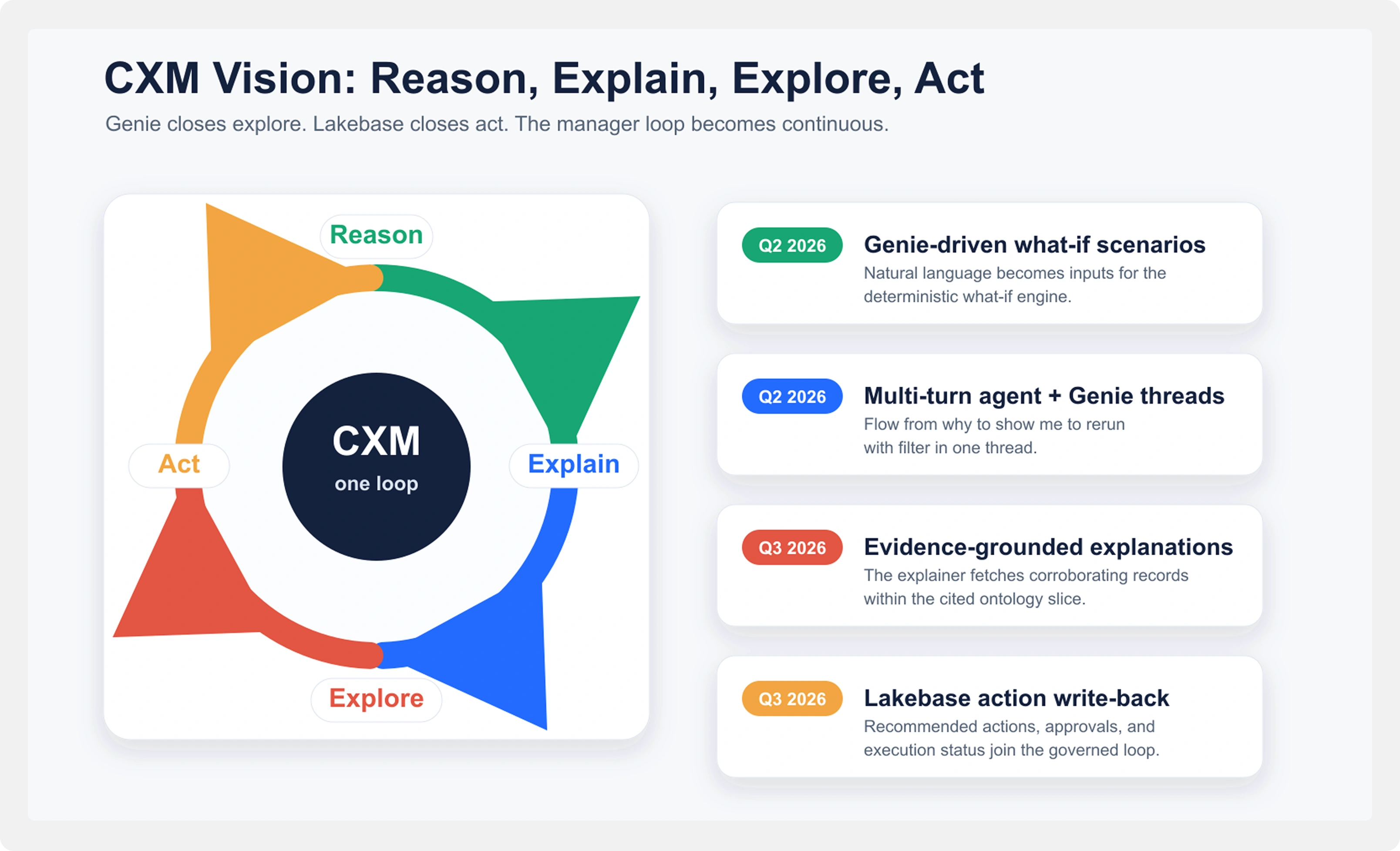
The Genie integration shipped to pilot customers in April 2026. The broader roadmap lands across Q2 and Q3:
Genie-driven what-if scenarios (Q2 2026)
Users pose scenarios in natural language, and Genie translates that intent into engine inputs for our deterministic what-if engine.
Multi-turn conversations (Q2 2026)
Merging agent findings and Genie follow-ups into a single thread.
Action write-back via Lakebase (Q3 2026)
Genie-mediated read patterns will sit alongside operational write patterns. A user can ask Genie to show open actions and then approve them, triggering downstream updates via Lakebase.
Evidence-grounded explanations (Q3 2026)
The explainer will call Genie queries to fetch specific records that prove the engine’s findings.
With Genie’s evolution into an agentic analytics layer, and Agent Garage’s ability to operationalize that intelligence, enterprises can finally unify Data, Reasoning, Decisioning, and Execution.
At Celebal Technologies, we see this as the next frontier of Data & AI on Databricks, building intelligent enterprises that do not just understand their business better but operate it better. With Agent Garage, that future is already being built.
The CXM Vision: Reasoning, Exploring, and Acting
The Causal Experience Manager (CXM) thesis is simple: causal intelligence becomes a manager, not a dashboard, when it can reason, explain, explore, and act in one loop. Genie closes the "explore" gap. Lakebase will close the "act" gap.
A year ago, asking "why" required a data team. Today, it requires a question. That is the shift the Brickbuilder accelerator is built around.
CausalX does not replace the data team; it gives every leader the first ten minutes back.