



Engineering the Pricing Cockpit:
Solving for Latency and Elasticity
on the Data Intelligence Platform

Pricing is no longer limited by strategy. It is constrained by how quickly systems can respond to real-world signals.
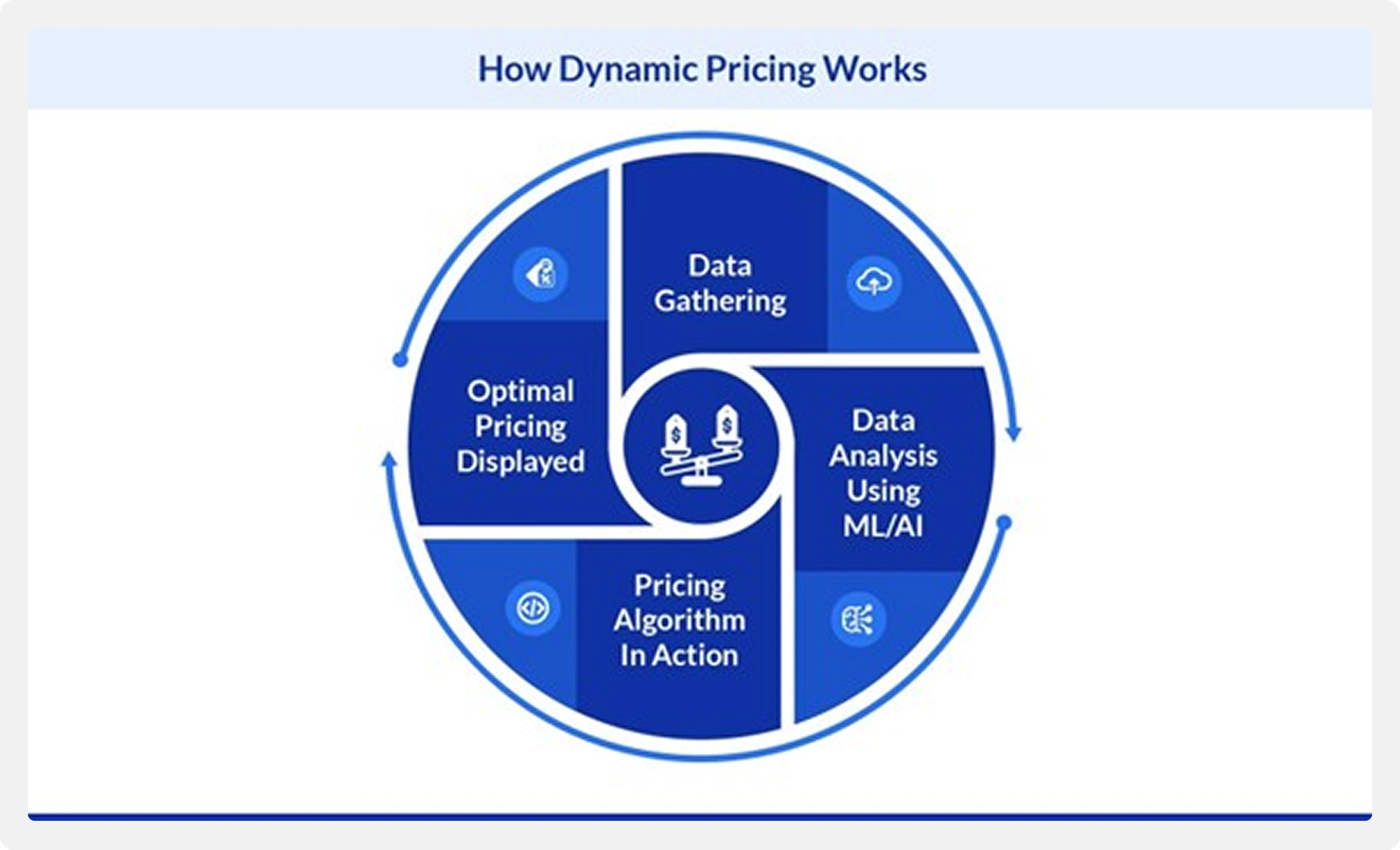
Dynamic pricing adjusts prices in real time based on demand, competition, customer behavior, and market conditions. Across industries such as retail, aviation, and hospitality, the goal remains the same. Align pricing with what the market will bear at any given moment.
AI-driven pricing can increase total revenue by up to 5% without volume loss, and the global dynamic pricing software market is projected to grow from about $4 billion in 2026 to roughly $6.9 billion by 2030. Yet most enterprises still rely on batch pipelines, where pricing operates as a disconnected logic layer rather than a real-time system.
At Celebal Tech, we move beyond this model by building our Dynamic Pricing Solution natively on Databricks. Pricing evolves into a real-time System of Intelligence that connects data, models, and decisions, further enhanced by conversational insights through Databricks Genie.
Beyond the Medallion: Handling High Concurrency Ingestion
The foundation of any pricing engine is its ability to ingest disparate signals without bottlenecking. We use LakeFlow to orchestrate streaming ingestion of competitor feeds, behavioral signals (search history, shortlisted items, add to cart events), and inventory constraints at scale.
The technical breakthrough here is not just storage in Delta Lake; it is point in time enrichment. We layer a feature store on top of the lake so that when a model calculates price elasticity or demand sensitivity, it sees the exact state of the market at the moment of the user’s click—not a stale snapshot from a nightly batch run. This ensures that every pricing decision is grounded in the most up to date context available.
The Engine Room: Probabilistic Forecasting and Human Behavior Modeling
Legacy revenue management systems rely on rigid “if then” rules that quickly become brittle in volatile markets. Our engine instead uses probabilistic forecasting and supervised machine learning to estimate not a single demand number, but a distribution of outcomes with specific confidence intervals.
Our engine goes beyond basic demand forecasting by building behavior informed ML models that capture how customers respond to different price points, offers, and contextual cues: time of day, channel, promotion framing, and anchor prices. By combining transactional data with behavioral signals such as browse patterns, abandonment events, and past price sensitivity, we learn not just what people buy, but how they react to different pricing treatments.
This approach is consistent with recent work in behavioral pricing and consumer behavior analytics, which show that models incorporating behavioral economics outperform pure econometric equations in real world settings. Revenue Managers can then tune elasticity assumptions not just around “average users,” but around specific behavioral segments (deal seekers vs. convenience buyers, loyalty program members vs. one off travelers).
A common technical risk in dynamic pricing is the “death spiral,” where competing AI models keep undercutting each other. To prevent this, our solution embeds business and regulatory guardrails—price floors, ceilings, and parity rules—directly into the engine. These act as hard coded “circuit breakers” that ensure model outputs never violate commercial intent, channel policies, or regulatory constraints.
Operationalizing Conversation: The Genie Integration Strategy
The hardest part of deploying AI in revenue management is trust. A Revenue Manager will rarely approve a 15% price hike without understanding the “why.”
This is where Databricks Genie becomes more than a chatbot; it is a natural language window into the MLflow Model Registry and the underlying feature catalog. By exposing reason codes, demand thresholds, and elasticity signals directly to Genie, we turn days of manual SQL analysis into a conversational investigation.
We do not just “plug in” Genie. We curate a semantic layer in Unity Catalog, explicitly defining relationships between entities such as Route_Elasticity, Competitor_Fare_Index, and Load_Factor. When a leader asks, “Why did this price move?”, Genie does not guess; it queries the specific feature set that triggered the shift, making the AI’s logic explainable and auditable.
The Simulation Sandbox: Safe Testing Strategy
From an engineering perspective, we treat pricing strategies like code deployments. Before a new pricing logic or elasticity threshold reaches production, it is run through a What If Scenario Simulator—a digital twin of the market.
This sandbox simulates the second order effects of a price change, including how competitors might react or how demand curves might shift. In the What If Scenario Simulator, we also test how different behavioral levers, such as anchoring, bundling, and discount framing, affect customer flow and conversion rates. This lets Pricing Analysts see not only how a price change will move demand, but how it will shape customer journeys and perceived value, before the strategy ever hits production.
We track and version these strategy iterations in MLflow, so every price point is auditable, reproducible, and tied to a specific model, feature set, and configuration. This shift, from rigid “policy documents” to versioned, testable pricing logic, is what makes the system safe for enterprise scale revenue operations.
The Outcome: Yield Optimization as a Service
Our goal is to build a modular architecture that adapts to any industry; from Aviation yield management to Energy tariff optimization, from Retail e commerce to Hotel room pricing.
Multiple industry reports highlight that travel companies and retailers who implement dynamic pricing see meaningful improvements in occupancy, conversion, and margin by aligning prices with real time demand.
By unifying Mosaic AI for reasoning, Delta Lake for governed data, and MLflow for model lifecycle management, we create a platform where the commercial desk can finally operate at the speed of their data.
In the modern enterprise, you no longer need more data points; you need the intelligence to act on them. By combining governed data, probabilistic forecasting, and human behavior modeling, we move beyond static “price per SKU” logic to a true yield and experience engine that aligns what the business wants with how customers actually behave.
With Celebal Tech’s Dynamic Pricing Solution on Databricks, intelligence is just one question away.