



Operationalizing Agentic AI
with Databricks and
Agent Garage

Enterprise AI is not failing because of models. It is failing because enterprises cannot operationalize decisions at the speed of business.
Despite heavy investments in AI and data platforms, most organizations still operate in:
Siloed workflows
Delayed decision cycles
Disconnected systems
The result? Insights exist but action does not follow.
The Shift: From Insight Generation to Decision Execution
Databricks has fundamentally changed how enterprises manage data and AI through the Lakehouse, Unity Catalog, and now Agent Bricks and Genie Agent Mode.
But the next frontier is clear:
AI must not just answer questions. It must execute business decisions.
This is where Agent Garage comes in not as another AI layer, but as the execution fabric on top of Databricks.
Agent Garage on Databricks: Built for Enterprise-Scale Execution
Agent Garage is natively built on:

Mosaic AI Agent Framework

Agent Bricks

Unity Catalog

MLflow
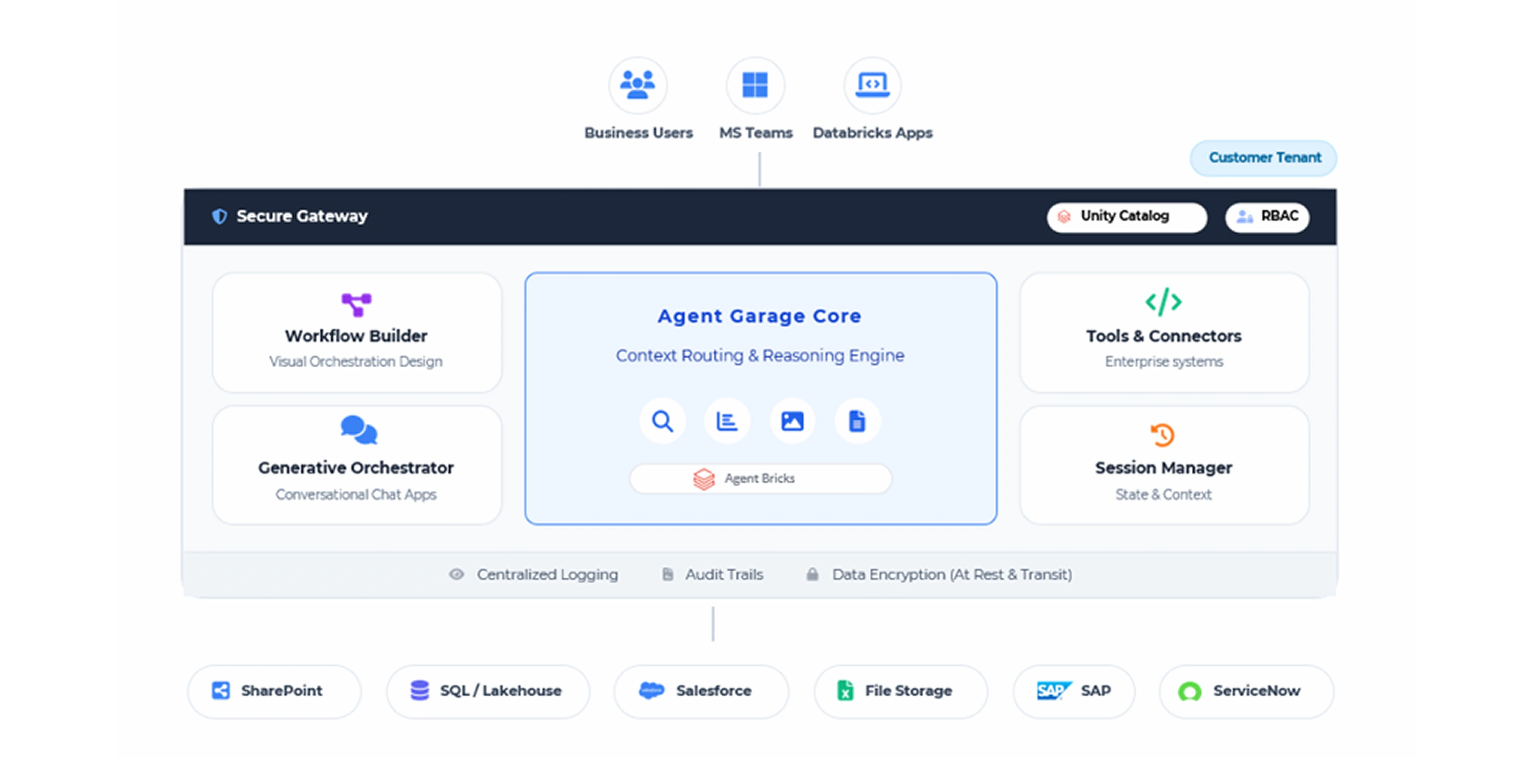
This architecture enables enterprises to move from:
Static dashboards
↓Real-time decision systems
Isolated models
↓Coordinated agent ecosystems
Manual workflows
↓Autonomous business processes
Intelligent Document Processing (IDP) as a First Class Agent Capability
Unstructured data continues to be one of the biggest bottlenecks in enterprise operations. Agent Garage extends agent capabilities to understand and act on documents such as invoices, contracts, bills of lading, compliance records, and onboarding forms. For example, in logistics onboarding, agents can ingest shipping documents, validate compliance, extract key fields, and trigger downstream workflows—reducing onboarding time from days to minutes.
Beyond Generic Agents: Domain Specific, Outcome-Driven Systems
The industry does not need more "RAG agents" or "chatbots." It needs business-native agents that understand operations, constraints, and trade-offs.
At CelebalTech, we focus on operational agents that embed directly into core business functions:
Rail Yard Optimization (Logistics & Supply Chain)
- Agents coordinate train arrivals, yard capacity, and unloading schedules
- Optimize routing decisions in real-time using operational constraints
IMPACT
Reduced congestion, improved turnaround time, higher asset utilization

Customer Onboarding in Shipping & Logistic
- Agents validate documents, perform compliance checks, and trigger downstream workflows
- Integrated with enterprise systems via governed connectors
IMPACT
Onboarding time reduced from days → minutes with full auditability

Downstream Refining Optimization (Energy)
- Agents coordinate crude scheduling, refining capacity, and product demand
- Continuously adjust plans based on market and operational signals
IMPACT
Improved refinery margins and reduced operational inefficiencies

Inventory & Demand Orchestration (Retail/CPG)
- Agents combine demand signals, pricing intelligence, and supply constraints
- Dynamically adjust replenishment and pricing strategies
IMPACT
Onboarding time reduced from days → minutes with full auditability
What We Do Differently
1. Federated Agent Architecture (A2A + MCP)
Agent Garage uses: Agent-to-Agent (A2A) communication protocols for coordination and Model Context Protocol (MCP) for standardized tool and data access
This enables: Cross-domain agent collaboration, seamless integration across enterprise systems, and reduced dependency on brittle custom integrations
2. Built-in Governance and Auditability
Governance is not an afterthought.
- Unity Catalog enforces data access and lineage
- Audit Agents monitor workflows, decisions, and actions
- Every agent interaction is traceable and explainable
3. Continuous Learning with MLflow
Using MLflow Agent Evaluation & Telemetry:
- Track agent performance across workflows
- Monitor decisions and outcomes
- Continuously improve agents based on real usage
4. Workflow + Generative App Convergence
Agent Garage unifies declarative workflows (structured execution) and generative apps (dynamic reasoning).
This allows enterprises to: Automate deterministic processes and enable intelligent decision-making in the same system
Genie Agent Mode: Democratizing Decision Intelligence
With Databricks Genie Agent Mode, business users can:
- Ask complex operational questions in natural language
- Trigger multi-agent reasoning workflows
- Move from question → decision → execution in one flow
EXAMPLE QUERY
"What's causing shipment delays in the West region and how do we recover SLA?"
BEHIND THE SCENES
Why This Matters Now
Enterprises are not looking for more dashboards.
They are looking for systems that:

Understand context
Make decisions
Execute actions
Databricks provides the data and AI foundation.
Agent Garage provides the execution layer that turns intelligence into
outcomes.
The Bottom Line
The future of enterprise AI is not chatbots. It is coordinated agent systems embedded into business operations.
Together, Databricks + Agent Garage enable enterprises to:
Compress decision cycles from hours to seconds
Execute complex workflows autonomously
Deliver measurable business impact at scale
"The real value of AI is not in what it predicts but in what it executes."