



Modernizing Legacy Data
Warehouses with Databricks
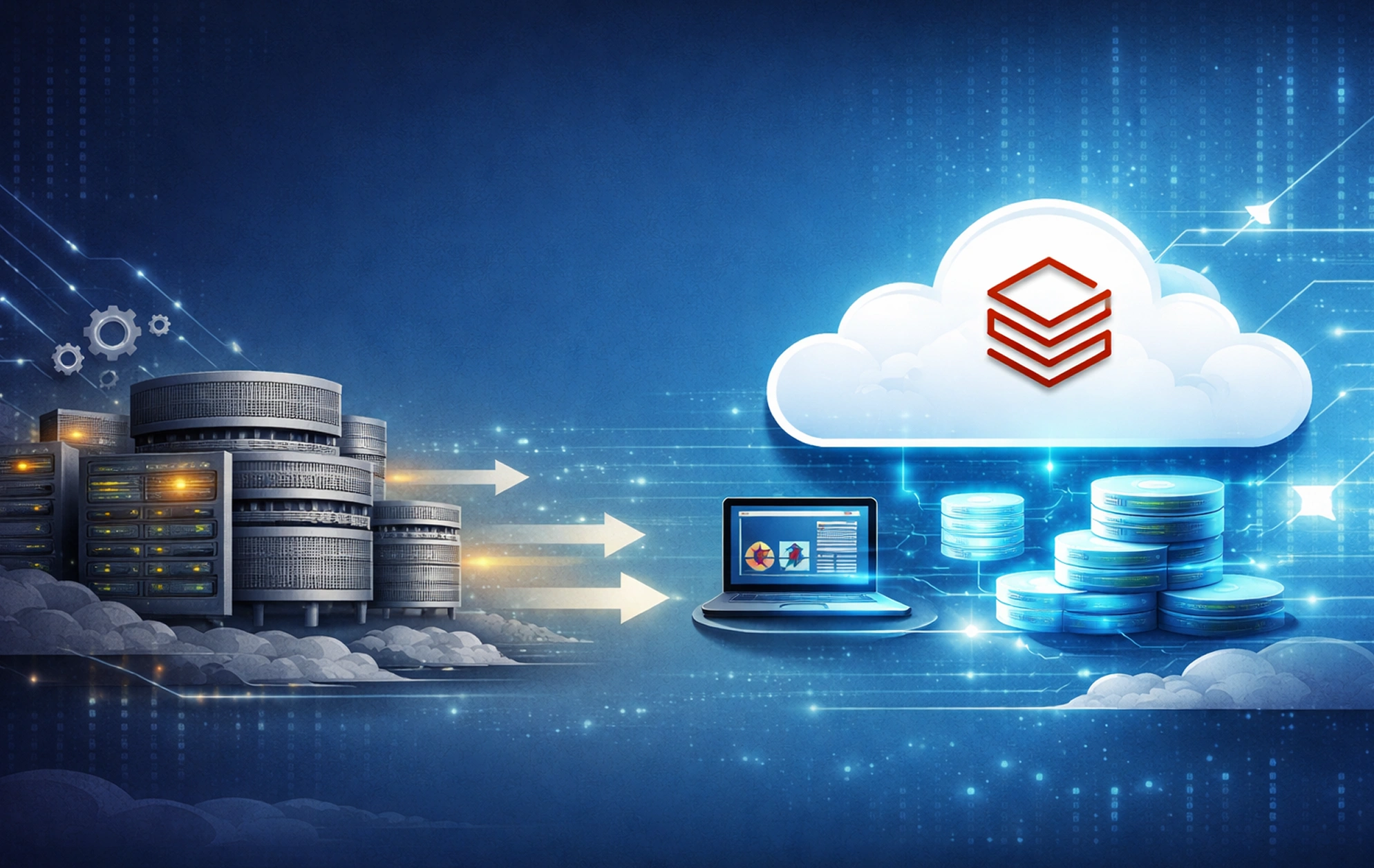
From Operational Bottlenecks to an AI-Ready Data Foundation
The role of data inside enterprises has fundamentally changed. Data is no longer confined to reporting or historical analysis. It now drives real-time decisions, powers intelligent applications, and forms the backbone of advanced analytics and AI initiatives. Yet many enterprises are still anchored to legacy data warehouses that were built in a very different era.
These platforms often appear stable, but beneath the surface they introduce growing friction. Rising costs, slow change cycles, fragmented governance, and limited flexibility make it harder to respond to business needs. As data volumes grow and AI adoption accelerates, these limitations become increasingly visible.
Databricks enables enterprises to move beyond traditional data warehouses and adopt a unified, governed, and AI-ready Data Intelligence Platform.
Why Legacy Data Warehouse Migration Is Inevitable
Traditional data warehouses were never designed for the demands of modern analytics and AI. They face challenges such as:
- High and unpredictable compute costs
- Data duplication across warehouses, lakes, and AI platforms
- Limited support for streaming and real-time analytics
- Separate, siloed tools for ETL, BI, ML, and AI
- Fragmented governance and inconsistent security controls
As data volumes grow and AI adoption accelerates, these limitations make legacy warehouses expensive, slow to evolve, and increasingly difficult to operate. Modern enterprises need platforms that can scale, support AI workloads, and provide reliable governance.
Why Databricks Is the Ideal Modernization Target

Governance Built In, Not Bolted On
With Unity Catalog, governance becomes centralized and consistent across analytics and AI workloads:·
- Unified metadata, lineage, and auditing
- Fine-grained access control
- Security applied consistently to data, features, and models

Lower and Predictable Total Cost of Ownership
Databricks decouples storage and compute, retires redundant platforms, optimizes queries with Photon, and leverages serverless compute to eliminate idle costs. Enterprises typically see a 30–40 percent reduction in cost after modernization.

Unified Platform for All Workloads
Databricks brings ETL, BI, streaming, machine learning, and GenAI together on a single Lakehouse foundation. This removes silos, reduces platform duplication, and ensures that all teams work with a consistent source of truth.

Faster Insights and Real-Time Analytics
Near-instant compute startup and optimized SQL execution reduce latency from ingestion to insight. Batch and streaming workloads run side by side without requiring a major architectural redesign.
Simpler, More Reliable Data Engineering
Delta Live Tables embed dependency management, data quality, and observability directly into pipelines, reducing operational risk and complexity.

Security by Design
Role-based access, isolation, and auditing are applied consistently across BI, analytics, and AI workloads.
Common Reasons Data Warehouse Migrations Fail
Despite the right technology, many migrations stall or underdeliver. Typical reasons include:
- Lift-and-shift mentality: Rebuilding old designs on new platforms limits ROI and performance gains
- Poor dependency visibility: Hidden ETL, BI, and orchestration dependencies surface late, causing rework
- Fragmented orchestration: External schedulers increase operational complexity
- Governance as an afterthought: Migration without metadata and security considerations breaks trust and compliance
- No future-state vision: Without AI and advanced analytics goals, migrations lose momentum
Understanding these pitfalls is critical before initiating any modernization program.
A Proven, End-to-End Migration Approach
Successful modernization requires a structured, platform-level approach that works across industries.
1. Strategic Assessment and Planning
Strategic assessment and planning involve inventorying data assets, pipelines, SQL workloads, and BI usage, classifying workloads based on complexity and business criticality, and defining migration waves, coexistence strategies, and success metrics.
Outcome: A realistic roadmap with clear risk visibility, enabling phased, controlled execution.
2. Data and Pipeline Modernization
Data and pipeline modernization focuses on refactoring legacy ETL pipelines for scalable execution, standardizing data formats to improve reliability and performance, and removing redundant transformations and duplicate datasets.
Outcome: Cleaner, faster, and more maintainable pipelines that serve both analytics and AI workloads.
3. Orchestration Simplification
Orchestration simplification involves consolidating scheduling and dependency management, reducing cross-tool orchestration complexity, and improving failure handling and observability.
Outcome: Lower operational overhead and faster recovery, with a single orchestration control plane.
4. BI and Analytics Modernization
BI and analytics modernization focuses on optimizing queries and dashboards for modern SQL engines, enabling governed self-service analytics, and validating results with business users to ensure trust.
Outcome: Faster insights and higher confidence across teams.
5. Performance and Cost Optimization
Performance and cost optimization focuses on right-sizing compute for each workload, eliminating idle and overprovisioned resources, and continuously tuning the platform to meet SLA and cost-efficiency targets.
Outcome: Predictable performance with reduced TCO.
6. Enable Advanced Analytics and AI
This approach emphasizes reusing trusted data across BI, ML, and GenAI workloads, extending governance and security policies to AI workloads, and avoiding duplication across platforms.
Outcome: A fully AI-ready analytics foundation that can scale with business needs.
Healthcare Lakehouse Migration: A Real-World Example
Client Context
A large healthcare enterprise managed a complex analytics platform characterized by fragmented data layers and duplicate datasets, Glue-based metadata with limited governance, Airflow-driven orchestration, a heavy dependency on Snowflake for publish layers, and a growing demand for AI and advanced analytics.
The enterprises needed a modernization program that reduced risk, improved performance, and enabled future AI workloads.
Migration Scope and Execution
The enterprises implemented a phased Lakehouse program:
- Prioritized approximately 20 high-impact use cases for early migration
- Migrated around 40 additional use cases in parallel to Databricks
- Transitioned from Glue Metastore to Unity Catalog
- Modernized orchestration with Databricks Workflows
- Adopted serverless compute where applicable
- Maintained controlled Snowflake federation during transition
Accelerators That Made the Migration Faster and Safer

1. Pre-Landing Copy Utility for Parallel Runs
This utility enabled Databricks pipelines to run alongside legacy pipelines without disruption. It created a parallel ingestion path where source data could be replicated safely for testing and validation.
Impact: Reduced migration risk, accelerated validation cycles, and ensured production stability.

2. Inventory Analysis and Lineage Framework
A metadata-driven framework scanned repositories for Airflow DAGs, SQL scripts, notebooks, and source-to-target table metadata, building end-to-end lineage.
Impact: Reduced manual discovery effort by 50–60 percent, revealed hidden dependencies, and accelerated migration planning.

3. Event-Driven File Arrival Triggers
Automatically detecting new files removed manual intervention and ensured pipelines always processed the latest data.
Impact: Improved data freshness, reliability, and operational simplicity.
4. Workflow Rationalization
Standardized workflow patterns replaced fragmented orchestration logic, mapping Airflow DAGs to Databricks Workflows and unifying retry, notification, and dependency handling.
Impact: A single control plane, faster troubleshooting, and lower operational costs.

5. Historical Data Migration Accelerator
Automated bulk migration of legacy datasets from Glue and Snowflake into managed Delta tables aligned with Unity Catalog.
Impact: About 80 percent reduction in manual effort, high accuracy, and faster environment readiness for analytics and AI.

6. Intelligent Data Reconciliation Engine
Performed automated, checksum-based validation to ensure completeness, schema accuracy, and row-level integrity between legacy and Lakehouse datasets.
Impact: 50–55 percent reduction in manual validation, faster reconciliation cycles, and high confidence in migrated data.

7. Reverse Sync Utility
Ensured downstream systems dependent on legacy tables continued operating by replicating updated data from the Lakehouse back to the old platform until full decommissioning.
Impact: Zero disruption to business operations and safe phased cutovers.
Measurable Migration Outcomes
The migration led to tangible, easy-to-measure results. Platform costs came down by nearly 30 to 40 percent, while SLA performance improved by around 30 percent. With analytics and AI workloads now governed under a single framework, teams have better visibility, control, and consistency across the platform. Operations are simpler and more streamlined, making onboarding faster and less effort-intensive. At the core, the enterprise now has a fully AI-ready Lakehouse foundation that is built to support future analytics and AI initiatives at scale.
Conclusion
Modernizing legacy data warehouses is a critical step for enterprises aiming to harness real-time insights, AI-driven analytics, and unified governance. Celebal Technologies guides enterprises through this transformation, ensuring migrations are platform-focused, secure, and cost-efficient. By leveraging Databricks Lakehouse, Delta Live Tables, and Unity Catalog, enterprises can reduce operational complexity, eliminate redundant systems, and discover faster, reliable insights. With our expertise, enterprises not only modernize their data infrastructure but also build an AI-ready foundation that accelerates innovation, improves decision-making, and positions them for scalable, future-proof growth.