



The Seat That Already Left
How the Dynamic Pricing Accelerator for Aviation turns
pricing from a reactive process into a real-time revenue
intelligence capability, built natively on Databricks Lakebase

An airline seat is the most perishable asset in commerce. The moment a flight departs with an empty row, that revenue is gone permanently. No markdown, no clearance sale, no second chance.
Airlines have always known this. What has changed is the speed at which the variables that determine the right price, demand signals, competitor moves, booking pace, inventory position, and elasticity by segment, now shift. A competitor can reprice a route in seconds. A weather event can reshape demand across a hub in minutes. A social media moment can fill or empty a cabin before a pricing analyst finishes their morning coffee.
The airlines that are pulling ahead are not the ones with the most data. They are the ones that have closed the gap between data and decision. Between a signal arriving and a pricing action being taken, simulated, approved, and published.
The Dynamic Pricing Accelerator for Aviation, a Databricks Brickbuilder Solution by Celebal Technologies, is built specifically for that gap. This blog explains what it is, why Databricks Lakebase is the infrastructure that makes it operationally viable, and what it delivers in practice.
The Infrastructure Gap Nobody Talks About
The standard narrative around airline pricing modernization focuses on models: better demand forecasts, smarter elasticity curves, more sophisticated optimization. That framing is correct but incomplete. The deeper problem is not model quality. It is operational infrastructure.
- Consider what a pricing decision actually requires in a modern airline environment. A revenue manager opens a dashboard that shows a route with weakening booking pace. To act on that signal, several things need to happen in sequence:
- Current fare, inventory, and booking curve data need to be assembled across systems that may not talk to each other
- A simulation needs to run against a demand model that knows today's competitor fares, not yesterday's
- The simulation result needs to persist somewhere, linked to the route, the analyst, and the timestamp
- A proposal needs to be drafted, reviewed, and approved through a workflow that creates an auditable record
- The approved action needs to reach the fare publication system before conditions change
- The outcome needs to feed back into the model so the next recommendation is better. In many airline environments, these steps still span multiple systems, spreadsheets, email threads, and manual handoffs. Every handoff introduces delay, and every delay increases the risk that market conditions will shift before a pricing action is approved and published.
The challenge is not a lack of data or forecasting models. Most airlines already have those capabilities. The real bottleneck lies in the operational infrastructure that connects insight to action. While the Lakehouse excels at analytics, pricing workflows also require a transactional layer that can support real-time simulations, proposal management, approvals, and decision tracking.
The question is no longer whether airlines have the right data. It is whether the infrastructure between data and decision-making is fast, durable, and governed enough to operate at market speed.
What Dynamic Pricing Actually Requires
Dynamic pricing is not simply about changing fares more frequently. It is about continuously aligning pricing decisions with current market conditions.
Every pricing decision must balance multiple factors, including demand trends, remaining inventory, time to departure, competitor pricing, customer price sensitivity, and commercial guardrails. The goal is to increase revenue without sacrificing yield or undermining future demand.
Achieving this requires two capabilities. The first is analytical: forecasting demand, understanding elasticity, monitoring competitors, and optimizing prices. The second is operational: simulating scenarios, managing approvals, publishing decisions, and learning from outcomes. While Databricks provides the analytical foundation, Lakebase delivers the operational layer needed to execute decisions at market speed.
A common technical risk in dynamic pricing is the “death spiral,” where competing AI models keep undercutting each other. To prevent this, our solution embeds business and regulatory guardrails— price floors, ceilings, and parity rules—directly into the engine. These act as hard coded “circuit breakers” that ensure model outputs never violate commercial intent, channel policies, or regulatory constraints.
Introducing the Dynamic Pricing Accelerator for Aviation
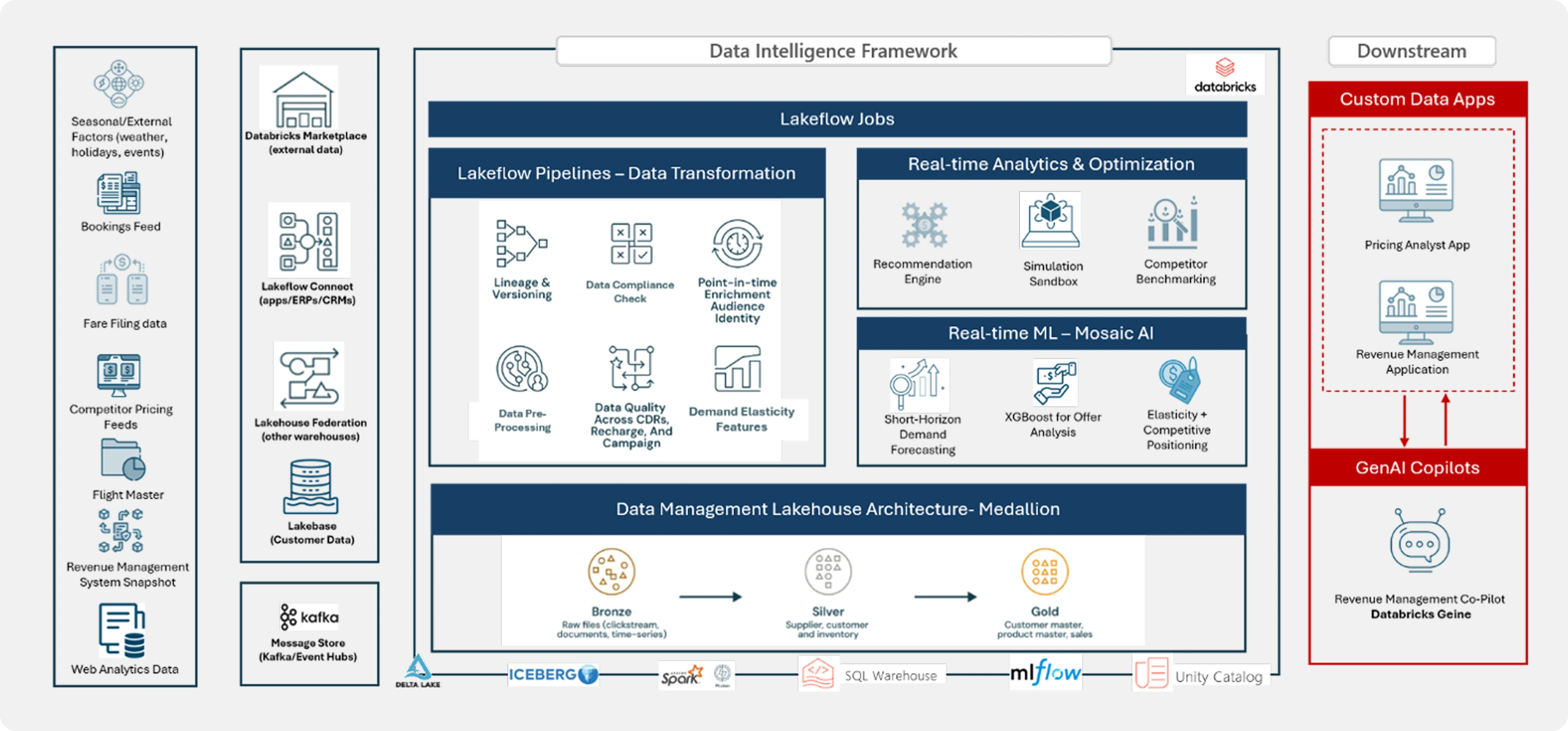
The Dynamic Pricing Accelerator for Aviation by Celebal Technologies is a Databricks-native solution accelerator that brings together demand intelligence, AI-powered recommendations, simulation, approval workflows, and conversational analytics into a single pricing experience.
The objective is not to replace human expertise. It is to augment pricing analysts and revenue managers with AI-powered intelligence so they can make faster, more informed, and more confident decisions while maintaining full business control, transparency, and governance.
Additional Features Empowering the Solution:
AI Recommendation Engine
Suggests pricing actions using demand, bookings, inventory, route performance, and competitor signals, with reasoning and expected impact.
Explainable AI
Explains every AI recommendation in simple business language so revenue teams can trust and act confidently.
Proposal and Approval Workflow
Manages pricing proposals, approvals, modifications, and decisions with full context and transactional records.
Competitor Intelligence
Tracks competitor fare movements and market positioning to guide pricing responses across routes.
Demand and Elasticity Intelligence
Identifies how pricing changes affect demand across routes, seasons, fare families, segments, and inventory levels.
Genie-Based AI Assistant
Enables revenue teams to ask questions, explore insights, review recommendations, and generate pricing summaries conversationally.
The accelerator is built around the below four core pillars that together cover the full pricing decision lifecycle.
Pricing Cockpit
The central workspace for pricing teams. The Pricing Cockpit gives revenue managers and analysts a unified view of route performance, pricing opportunities, competitor movement, AI recommendations, active simulations, and pending approvals.
Revenue Manager Dashboard
Built for commercial decision-makers, the dashboard provides visibility into revenue performance, booking pace, yield trends, route opportunities, competitive positioning, and pending pricing actions.
Pricing Analyst Workbench
Supports investigation and scenario planning. Analysts can evaluate demand patterns, fare performance, competitor activity, and customer response before creating pricing proposals.
Dynamic Simulation Engine
Before making a price change, airlines test possible outcomes. Each scenario runs in an isolated Lakebase branch and returns expected bookings, revenue impact, load factor movement, and risk level.
Why Lakebase Is the Operational Backbone
Databricks Lakebase is a fully managed, PostgreSQL-compatible operational database that runs natively inside the Databricks workspace. It is not an analytics store. It is not a cache. It is a transactional operational database with sub-10ms reads and writes, zero-copy branching, and native Unity Catalog governance.
In the Dynamic Pricing Accelerator, Lakebase is the layer that makes the pricing workflow operational rather than just analytical. Specifically, it holds:
Simulation state and branches
Every what-if scenario an analyst runs is a Lakebase branch: an isolated, zero-copy snapshot of operational state that can be scored, compared, and discarded without touching production data. An analyst can run a 4% fare reduction simulation on the Jaipur–Delhi route at 9:15 AM, compare it against a 5% scenario, and have both results persisted and linked to the route by 9:17 AM. The branch is what makes simulation a first-class operation rather than a notebook exercise.
Proposal and approval records
Every pricing proposal, including the route, fare family, current price, recommended price, simulation result, AI recommendation, confidence score, risk indicator, and approving manager, is written transactionally to Lakebase. Approval decisions are durable, auditable, and immediately retrievable. The email thread disappears from the workflow entirely.
Decision and intervention logs
Every causal chain from signal to action to outcome is logged. When a pricing action is taken, Lakebase records what the system recommended, what the analyst proposed, what the manager approved, and what the market did afterward.
That log is the closed feedback loop that makes future recommendations better.
Live agent and session context
Databricks Genie, the conversational intelligence layer integrated into the accelerator, needs sub-10ms access to current pricing context to answer questions in real time. When a revenue manager asks Genie why the AI recommended a 4% reduction rather than 5%, Genie reads the active simulation, the demand forecast, and the competitor position from Lakebase without waiting for a cluster to wake up. The answer arrives in the time it takes to type the question.
The split between Lakebase and the Lakehouse is deliberate and clean. Delta Lake and Unity Catalog hold the analytical truth: the demand models, the route performance history, the elasticity curves, the KPI datasets. Lakebase holds the operational truth: the live decisions, the active simulations, the approval state, the Genie session context. Each layer does exactly one thing, and the integration between them is where the value compounds.
The Architecture: Five Layers, One Decision Loop
The accelerator is organized around a continuous pricing decision loop. Every layer feeds the next, and the outcome of each decision improves the next one.
| Layer | Databricks Component | What It Does in the Pricing Loop |
|---|---|---|
| Data Foundation | Delta Lake + Unity Catalog | Unified commercial data: bookings, fares, inventory, competitor feeds, forecasts. Single governed source of truth across routes and fare families. |
| Intelligence | Databricks ML + Feature Store | Demand forecasting, elasticity modeling, and price optimization. Models trained on historical outcomes; features served from the Feature Store at low latency. |
| Operational Backbone | Databricks Lakebase | Simulation branches, proposal records, approval workflows, decision logs, Genie session state. The transactional layer that makes pricing operational rather than analytical. |
| Conversational Intelligence | Databricks Genie | Natural language interface over governed pricing data. Revenue managers and analysts query context, interrogate recommendations, and explore scenarios in plain English. |
| Governance | Unity Catalog | End-to-end lineage from raw booking data through model output to approved pricing action. Every recommendation traceable; every decision auditable. |
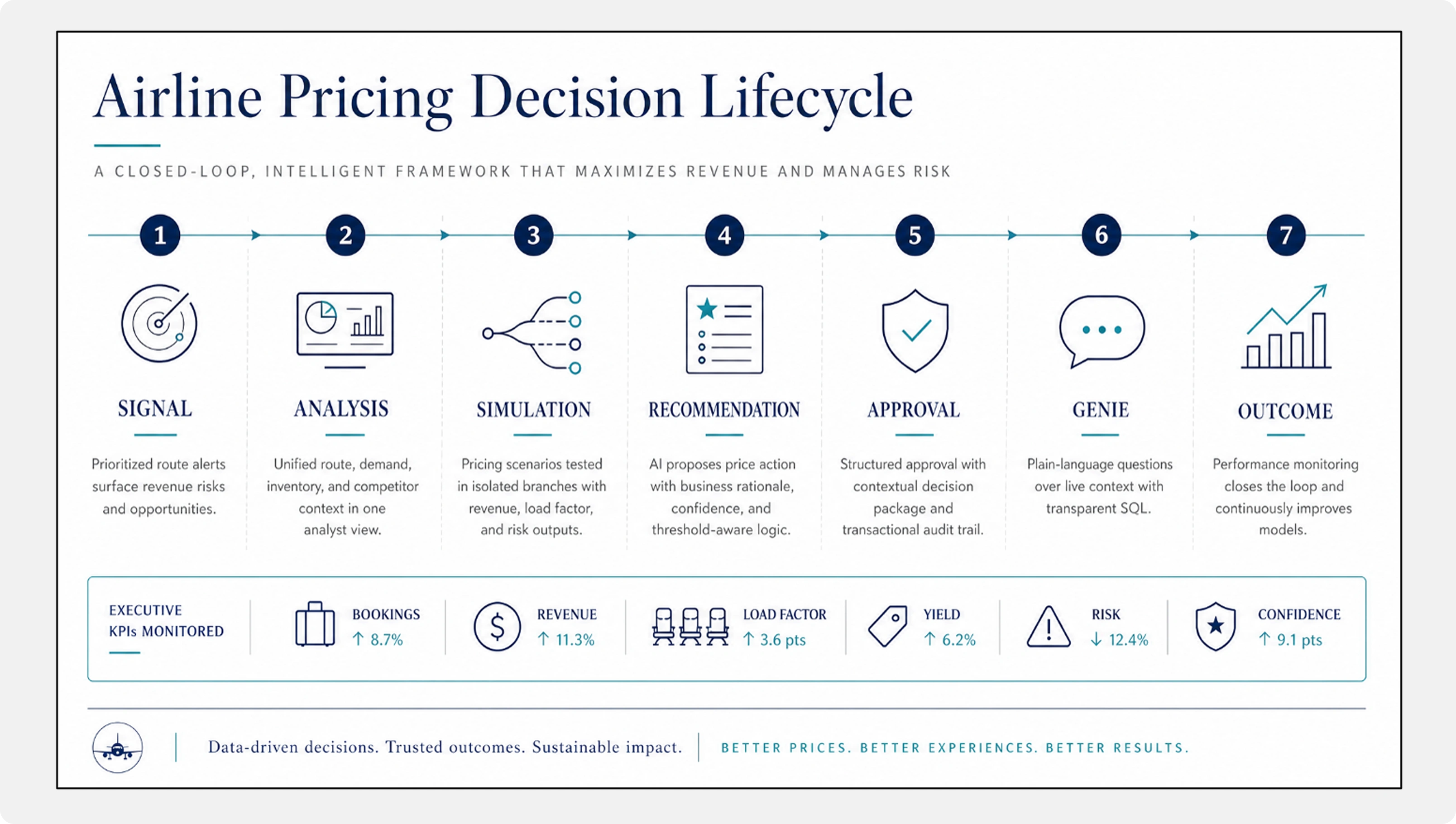
How a Pricing Decision Actually Works
The accelerator supports a complete pricing decision lifecycle. The following is not a product walkthrough. It is a description of what changes operationally when this infrastructure is in place.
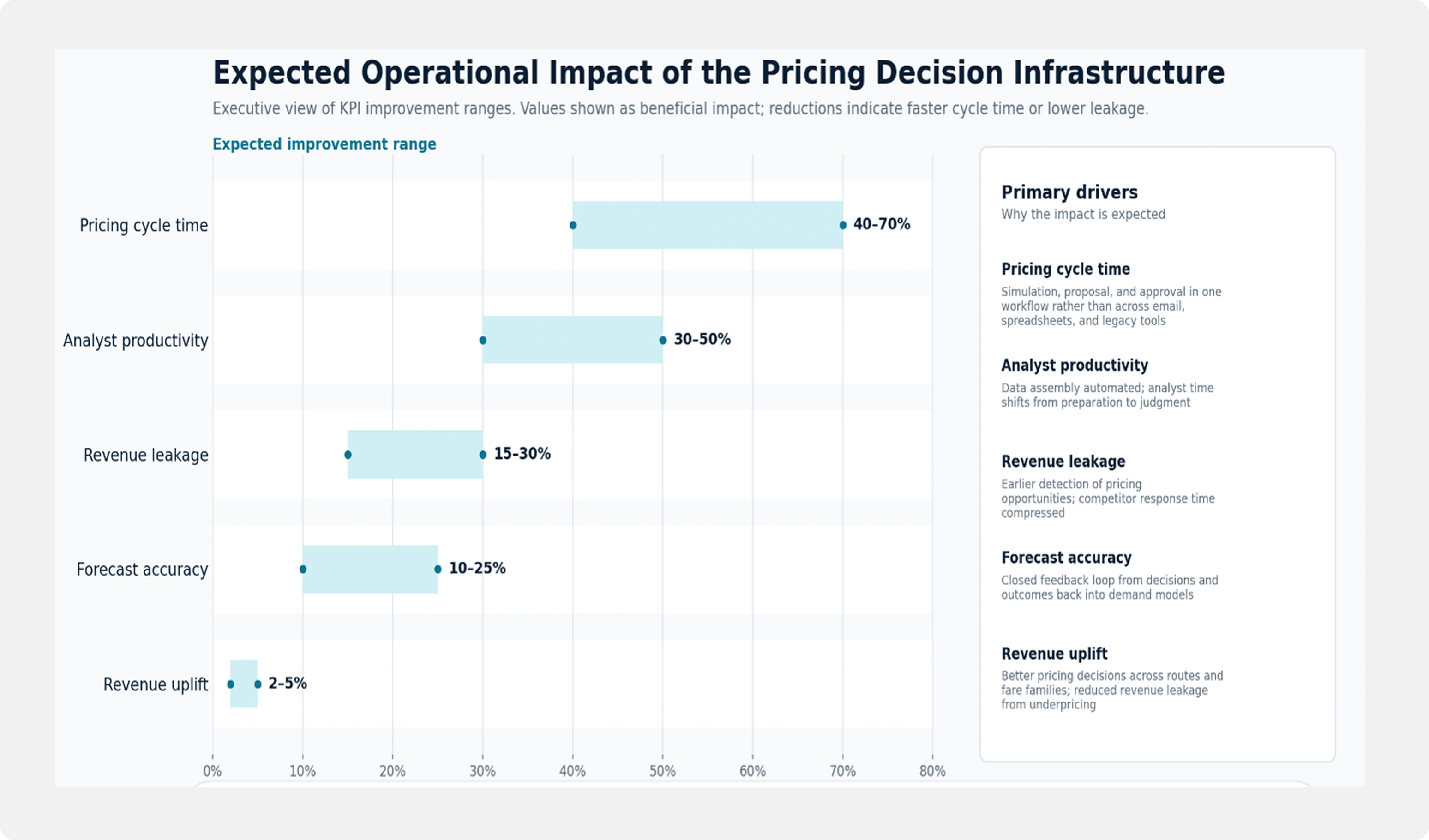
What This Delivers in Practice
The following outcome ranges are indicative and should be validated against each airline's current baseline. They reflect the direction and magnitude of improvement the accelerator is designed to drive.
Databricks Genie: Revenue Intelligence in Plain English
Most pricing intelligence tools require a technical user to extract insight. Genie changes that interaction model entirely.
In the accelerator, Genie is connected to governed pricing data in Unity Catalog and live operational context in Lakebase. A revenue manager can ask:
- "Show me routes where booking pace is more than 10% below forecast this week"
- "Why did the AI recommend holding fare on the morning bank out of Delhi yesterday?"
- "Which proposals are waiting for my approval and which have the highest revenue risk if I delay?"
Genie does not replace the Revenue Manager Dashboard or the Analyst Workbench. It sits alongside them as a faster path to context for users who know what they need to understand but do not want to navigate to five different views to find it.
For executive stakeholders, Genie provides the same access to governed pricing intelligence without requiring dashboard training. For compliance and audit teams, every Genie answer surfaces the underlying SQL, making the reasoning behind any pricing insight transparent and repeatable.
What Lakebase Specifically Makes Possible
It is worth being precise about which Lakebase capabilities are architectural dependencies of the accelerator, not just infrastructure preferences.
Sub-10ms transactional reads and writes
The simulation engine, the approval workflow, and Genie's live context reads all require response times in single-digit milliseconds. At Delta Lake latency, these interactions are too slow to feel operational. At Lakebase latency, they feel instant. That is not a performance preference; it is the difference between a tool analysts use during a decision and a tool they consult before one.
Zero-copy branching
Lakebase's branching architecture lets the simulation engine spin up isolated copies of operational state without duplicating data. An analyst runs a dozen what-if scenarios across a morning bank of flights. Each scenario is a branch: isolated, scored, and discarded or promoted. Production state is never at risk. Without this capability, simulation would require either a separate environment (expensive, slow) or careful isolation logic (fragile, complex).
Native Unity Catalog governance
Because Lakebase runs inside the Databricks workspace, every operational record, every proposal, every approval, every decision log, is governed by the same Unity Catalog permissions and lineage tracking that covers the analytical layer. There is no second governance perimeter to manage. The security team audits one environment. The compliance team queries one audit trail.
Serverless scale-to-zero
Airlines do not have flat pricing workloads. The morning bank generates intense activity for two hours. Overnight, volume drops near zero. Lakebase's serverless model means compute costs match actual usage. Idle hours cost nothing. Peak hours scale to meet demand. For a solution deployed across multiple airline customers, the cost model is viable without always-on provisioning.
What This Means for Airline Commercial Leaders
Architecture decisions are ultimately commercial decisions. The following is what the accelerator actually changes for each stakeholder who touches the pricing workflow.
Chief Commercial Officers
Full visibility into pricing performance across routes, fare families, and booking windows, with the ability to interrogate any recommendation in plain language. Pricing governance moves from a periodic review into a continuous, auditable process.
Revenue Management Leaders
Faster review cycles because proposals arrive with full context attached. Simulation results attached to proposals mean the manager is evaluating a tested scenario, not a request for permission to test one. Decisions are documented automatically; the approval email chain is replaced by a structured, queryable record.
Pricing Analysts
Data assembly time drops significantly because the workbench pulls relevant context automatically. Simulation runs in seconds rather than hours. The gap between an observation and a proposal narrows from a half day to a focused analytical session.
Data and AI Platform Teams
A working reference for how AI can be operationalized into a real commercial workflow on Databricks: demand models serving Feature Store recommendations generated with explanations, Genie connected to governed data, Lakebase holding the operational layer, Unity Catalog governing end to end.
Beyond Aviation: The Same Architecture, Different Industries
The Dynamic Pricing Accelerator is designed around aviation, but the architecture is not aviation-specific. The same stack, demand forecasting, simulation branching, transactional decision logs, explainable recommendations, and conversational intelligence applies wherever pricing decisions are constrained by inventory, perishability, competitive dynamics, and the need for a governed audit trail.
| Industry | Pricing Problem | How the Architecture Applies |
|---|---|---|
| Hospitality | Occupancy-based rate management; event-driven demand spikes | Simulation branches model room-type scenarios; Lakebase holds rate decisions per property |
| Retail and e-commerce | SKU-level markdown and promotion timing | Elasticity models by segment and channel; approval workflow governs markdown authority |
| Logistics and freight | Spot market lane pricing; capacity-constrained rate setting | Real-time competitor feeds; transactional decision logs for contracted vs spot-rate governance |
| Media and entertainment | Dynamic ticket pricing; event capacity monetization | Demand simulation per venue tier; Genie surfaces sell-through pace to commercial teams |
| Telecom | Plan pricing, bundle optimization, retention offers | Churn-risk signals feed recommendation engines; approval workflow governs offer authority |
Where This Goes Next: From Fare Optimization to Revenue Intelligence
Dynamic pricing is the foundation, not the ceiling. The same Databricks-native architecture that powers fare decisions today is designed to expand into a broader revenue optimization capability as the platform matures. The roadmap is organized around what comes naturally after pricing intelligence is in place.
| Capability | What It Adds |
|---|---|
| Ancillary Pricing | Extend optimization to baggage, seat selection, meals, lounge access, and priority boarding using the same demand and elasticity models |
| Personalized Offers | Move from route-level pricing to customer-segment offers built on loyalty data, booking behavior, and travel context |
| Promotion Optimization | Recommend targeted promotions by route, season, channel, and segment, with expected revenue impact scored before launch |
| Loyalty Optimization | Improve upgrade offers, redemption strategies, and loyalty-based pricing decisions using the same governance layer |
| Network Planning Insights | Feed pricing and demand intelligence into route profitability and capacity decisions, connecting commercial and operations teams |
| Autonomous Pricing Agents | AI agents that identify opportunities, run simulations, draft proposals, and route for approval without manual initiation |
| Cross-Channel Pricing | Optimize pricing consistently across website, mobile, OTA, corporate booking, and call center channels |
The progression from dynamic pricing to full revenue intelligence does not require rebuilding the platform. Because the accelerator is built natively on Databricks, each capability above extends what is already in place: the demand models, the Lakebase operational layer, the Unity Catalog governance, and the Genie conversational interface. The foundation compounds.
The Shift That Matters
Airlines have had demand data for decades. Revenue management as a discipline has existed since the 1980s. What has changed is not the availability of data or even the quality of models. What has changed is the speed at which pricing decisions need to be made, and the degree to which that speed is now constrained by operational infrastructure rather than analytical capability.
The Dynamic Pricing Accelerator for Aviation closes the infrastructure gap. It connects the Databricks analytical platform to a transactional operational layer that runs at the speed pricing workflows actually require, governed by the same Unity Catalog that governs everything else in the Databricks environment.
The result is not just better pricing recommendations. It is a fundamentally different relationship between the signal that something needs to change and the action that changes it.
The competitive advantage in airline pricing no longer comes from having better models. It comes from closing the distance between a signal and a decision. That distance is now measured in minutes. Lakebase is what makes it so.
See the Dynamic Pricing Accelerator in action
Interested in how Dynamic Pricing Accelerator can work for your enterprise? Reach out at enterprisesales@celebaltech.com